Airlie Australian Share Fund

Dear Investor,
This letter provides insight into our investment process and how the fund performed amid a volatile 12 months for the S&P/ASX 200. Please look to our June 2026 Quarterly Commentary for a more detailed assessment of performance and individual stock attribution for the quarter.
The Airlie Australian Share Fund returned 4.1% net of fees for FY26, 2% behind the index return of 6.1% for FY26. While it was disappointing to underperform the S&P/ASX 200 for the financial year, we note a number of significant headwinds that had weighed on performance over the preceding 12 months reversed sharply in the final quarter and are now turning to performance tailwinds, such that FY27 looks like a fantastic field for active stock-pickers. This was evidenced in the fund’s 10.6% absolute return for the final quarter of the financial year, 6.5% ahead of the index return of 4.1%.
The top three relative contributors to performance for FY26 were BHP Group (+68%), BlueScope Steel (+48.7%) and IGO (+81%). The top three relative detractors were EBOS Group (-38%, since exited), Resmed (-26%) and Xero (-55%).
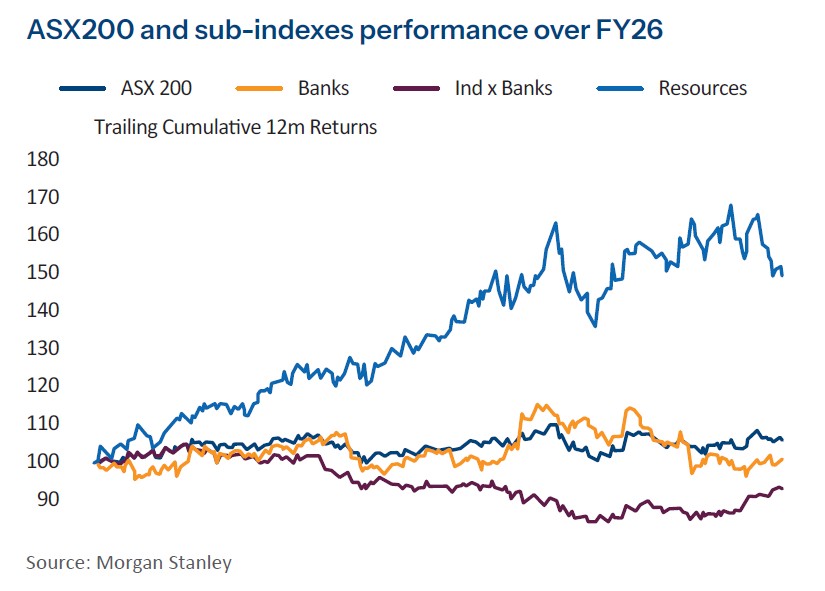
The tale of the tape for FY26 is most easily visualised by the chart. The total return for resources (+50%) gapped the field with industrials (-4%) struggling against sluggish demand with cost pressures (and note industrials ex-banks fared even worse), leading to a total return for the S&P/ASX 200 of +6%. Thematically, the big news story in global markets in FY26 was the ongoing evolution of Artificial Intelligence (AI), as the physical expansion of AI-related data centres gained pace. The largest expression of this theme for the ASX has turned out to be the diversified miners, as BHP and RIO re-rated substantially over the year with rising copper prices. While data‑centre-driven demand for copper is only small within the scheme of total demand, it comes on top of incremental demand related to the energy transition. When rising demand meets structural undersupply and incredibly long project lead times, prices rise. The combination of strong demand and restricted supply has similarly driven lithium and US steel spreads. As such, it is unsurprising that our best performers for the year were BHP, BlueScope and IGO.
At Airlie, we define our investment style as focusing on “undervalued quality”. For us, quality encompasses three factors. First, a quality balance sheet is a prerequisite for investment: we will invest only in companies that have the appropriate financial strength for the business model they are in. This varies by sector; a business like The Lottery Corp, which has multi-decade exclusive state lottery licences and very few capital needs, can and indeed should carry a higher level of debt relative to earnings than a retailer, which faces operational leverage and varying end-customer demand. Second, we assess business quality, which we define as the ability to earn a high return on capital deployed, as well as having opportunities to grow at attractive rates on incremental capital. Third, we look for high-quality management teams, those with an established track record of good capital allocation. As ever, the “x factor” with investing is finding situations where the first three factors are underappreciated in the prevailing share price of the company.
Businesses change slowly, yet share prices change incredibly quickly, and that volatility is increasing, in our view, as a result of the changing nature of market participants. Hedge funds, quantitative strategies, passive investing – many more share trades today take place for reasons other than a fundamental assessment of a company’s future prospects. We saw this frequently in FY26: surely the poster child for such volatility this year was Cochlear, a company that had long been considered one of the highest-quality businesses on the ASX, with a long growth runway and low disruption risk. This was reflected in a very high valuation, with the company trading on an average multiple of 42x earnings over the last decade.
Businesses change slowly, yet share prices change incredibly quickly, and that volatility is increasing, in our view, as a result of the changing nature of market participants.
In April, a substantial earnings downgrade saw the stock fall over 40% in one day, and the shares now trade on 22x earnings. There are multiple lessons for investors in this cautionary tale. To us, it highlights the risks in paying a very high multiple for any business. The world is an uncertain and complex place and it is rare for any business to manage to avoid a hiccup. For Cochlear, the hiccup was manifold and included some potentially cyclical factors like consumer weakness in North America as well as some permanent changes such as implant reimbursement levels in China. When these sorts of changes coincide with a high starting valuation, an investor faces the chance of permanent capital impairment, something we obviously seek to avoid by weighting the portfolio away from companies with excessively optimistic valuations.
Through this lens, FY26 has been an exciting year for us as investors seeking undervalued quality. Many companies that have long been considered the highest-quality businesses on the ASX, and have traded on eye-wateringly high multiples accordingly, have de-rated significantly over the year, and are now firmly in our hunting ground. As such, we have had the highest rate of new ideas added to the portfolio this year versus any other year since the fund’s inception in 2018. Global, capital-light businesses that we have long admired, like Car Group, Pinnacle and Xero, have faced substantial de-rates, providing us the opportunity to invest at attractive prices.
We have funded these new ideas with some exits from long-term holdings. A thorough assessment of CSL’s medium-term prospects led us to significantly impair our long-term valuation, as we believe the company faces ongoing profit pool erosion in albumin, iron and flu. As such, we exited in early CY26. We also exited Charter Hall for valuation reasons, and EBOS Group after a management change, an earnings downgrade and deteriorating financial strength.
As we look to FY27, we believe the field looks decent for absolute returns in some parts of the market (beaten-up quality industrials, ongoing strength likely in commodities). However, the outlook for the banks looks poor. Falling house prices will weigh on credit growth, bad debts are likely to tick up, and competition looks to be intensifying. We anticipate the de-rating of the banks that began in March is likely to continue throughout FY27. Given the c.25% index weight of the domestic banks, this will weigh on index returns, and in our view justifies the large (c.10%) underweight position we hold.
As ever, we thank you for your support over FY26.


Emma Fisher,
Deputy Head of Australian Equities and Portfolio Manager


Joe Wright,
Deputy Portfolio Manager